Wednesday, August 7, 2013

Moving Beyond the Picturesque...

   In the late 18th century, William Gilpin coined the phrase "picturesque".  It was a time of romantic revival in literature, poetry and painting and tourist flocked to these so-called picturesque locations all over Europe in order to ponder the sublime beauty of remote landscapes.  Some also brought along "Claude glasses", named after the French painter Claude Lorrain ( you can go here to see the artist's work.) who was noted for his romantic, smokey landscapes.  These devices framed and tinted the landscape so the viewer saw it not as nature but as a painting.  That is what picturesque means - in the manner of pictures - fit to be made into a picture or painting.
  
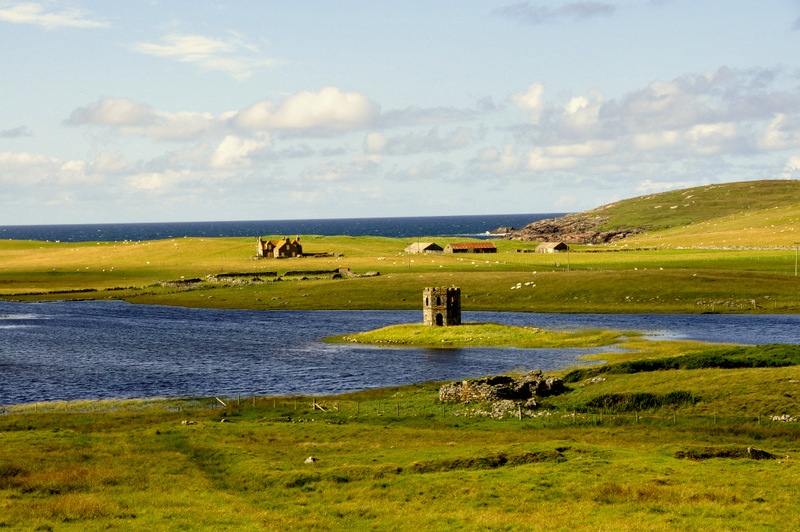
This was also the time when landscape designers added "follies" to the gardens of wealthy clients so that the vista could be considered more picturesque.  Somehow, these man-made elements added beauty the natural landscape lacked.  Faux Greek temples and Egyptian obelisques came to dot the English countryside of the great 19th century estates.   I made the photograph on the left on North Uist in the Outer Hebrides of Scotland.  This faux tower was created by the lord who owned the land to enhance the vista.

Impossible Places
   I think many photographers are stuck in this mode of thinking as they go out to photograph the world around them.  Like the tourist of the late 18th and especially the 19th century,  they go in search of the picturesque - landscapes that they feel are worthy of being photographed.  This implies that there is an abstract and universally agreed upon criteria for this kind of picture making and I must admit to feeling its pull from time to time.  If we are honest with ourselves, we all do.

   The biggest shift in my photography came when I realized that my images could have another role to play - beyond the picturesque.  They can also have a revelatory function and they need not be "pretty" at all to fulfill this function.  In fact, sometimes the most ordinary, the most mundane, can be the most revealing.

   Now I want to be clear, I'm not opposed to the beautiful and sublime landscape.  Basking in the beauty of these places is both theraputic and wonderfully uplifting.  I simply want to point out that to really call ourselves contemplative photographers we must also be willing to delve into the neglected, the abandoned, the "unpicturesque" locations because they hold their own kind of truth and revelation.


Tuesday, August 6, 2013

Hindsight, Foresight...What about Nowsight?

   Visual listening is all about cultivating our "nowsight".   Before you say it, yes, I know nowsight isn't even a word.  That, I think, is the whole problem.  We spend so much of our time looking back or looking forward that the now escapes us.  With visual listening, we calm the wandering mind and focus our attention on the right here, right now, right before our eyes.  Of all contemplative photography concepts, this is the one most people have the hardest time with.

Yellow Flower, Yellow Flower, Yellow Flower....

   Becoming nowsightful (another "non-word", I do love making up words!) is learning to see in the present moment only what is in front of you. It would seem so easy to do but, in fact, our monkey minds are rarely stilled to this degree. Meditation certainly helps but when you are walking around in a landscape this can be difficult to pull off.

    One way I try to stay in the nowsightful mind is through mind journaling, saying out loud what I would write down if I wasn't in motion. I will say a word or phrase that describes something right in front of me like "tall grass".  As I proceed through the tall grass I repeat it until I come to another area, then I'll change my mantra..."rocky road, rocky road, rocky road".   Of course, you don't have to say it out loud, just chant it in your mind.  Probably a better idea if you aren't totally alone; you don't want people to think you've taken complete leave of your senses!  If you are describing, verbalizing, something right in front of you and repeating it over and over, your mind will focus on that one idea alone. It will be less prone to wander away to what you might have for dinner tonight.  Mind journaling keeps me nowsightful.

   Christine Valters Painter wrote a lovely post for this blog about quieting the mind...read or re-read it here.  I also wrote a post, Cultivating the Quiet Mind with ideas you might find useful.  You can refer to that post here.  Finally, below you will find an interesting article and short video about the benefits of stilling the monkey mind...


Monday, August 5, 2013

A Thought for Today - Simplicity....

   I've been thinking a lot about simplicity lately.  My stay at the Pleasant Hill Shaker Village in Kentucky clearly influenced me.  The folio of images I made there contain many almost minimalist studies that I found compelling.

   I will continued this approach in Canterbury, New Hampshire at the Shaker village there when I visit next week.  It is easy to find simplicity in a place that puts a premium on quiet, "empty" space.  This way of framing our work does not rely on a kind of institutional simplicity however.  The photograph on the right was made at a French chateau that was anything but simple.  Still, in a window niche on the second floor, I found this moment of stark simplicity because my eye sought it out...cried for it even in all the garish opulence I was surrounded by.

   What I wrote on this image also refers to where you go to photograph...don't worry about finding striking, breath taking landscapes or glorious sunsets.  Wherever you find yourself, whatever is there, is enough.  Open up your heart to find the simplicity of, and the beauty, in the commonplace...the sacred in the ordinary.


Sunday, August 4, 2013

PhotoTao Card #34 - Satisfaction

  
Satisfaction
Be content to do things well.  Let the world 
take care of itself.  Live your life in the peace
of having conquered the fear of not knowing.
- Exercise -
   Set aside a day to work on just one photographic
challenge, like making photographs in low light
or bright sun.  Explore every facet of the challenge.
Look at other photographers' solutions but
invent your own.  Don't worry if you can't 
master it in one try.  Be satisfied with
the one try.


Monhegan Reflections
    A challenge you might like to try, especially if you are in a city, is to photograph the street scenes through only the reflections in the shop windows. This reflection was on Monhegan and I love the softly blurred image. You have to remember to focus your lens on the reflection and not on the items behind the glass!  This is also an interesting way to photograph people on the street.  Play with it in photoshop to create a more surreal effect.  Using a slow shutter speed will add to the unworldly quality of the image.


Saturday, August 3, 2013

The A, B, C's of Contemplative Photography - C

C is for Contemplative (and also for compassion and connection and community and contentment and collect....)

   Well, that's pretty obvious!  What does it actually mean to be a "contemplative" photographer though?  I am always asked that.  It is still a somewhat unfamiliar term to most people.  But it really depends on who you ask!  I discussed the Miksang approach in a post which you can read here and my weekend retreat with Kim Manley Ort was based on this approach.  It was a wonderful experience for fine tuning my perceptual skills.

   In the blog post I compared the Miksang approach to contemplative photography to my personal approach which goes beyond mere perception and delves into the metaphoric implications of the photographic image.  This is really what interests me the most in the practice of contemplative photography.  The images open my mind to all sorts of revelatory possibilities.

   Contemplation is often associated with religious practice but this needn't be so.  To "contemplate" is to think deeply about something.  I also like the idea of cultivating (another good C word!) a contemplative and open-ended mind as opposed to the dualistic and judgmental mind. Here is a link to the Center for the Contemplative Mind in Society page of contemplative practices.  I've used their "tree" in my lectures and it gives a good overview of the diversity of the concept of contemplation.

   What it means to me to be a contemplative photographer is to use my images as a basis for my daily contemplative journaling.  I approach contemplative photography through a Taoist perspective.  I find so many connections and it expands my practice in so many ways. You can see my series on The Photographic Sage here and it may be helpful to review it.  For those who are new to this blog it is a good introduction to this pairing, photography and Taoist thought, which is the foundation of my approach to the notion of contemplative photography.


Friday, August 2, 2013

Your Point of View...

   On my stay on Monhegan Island I shared the cottage with 6 other photographers.  We all had our own interests and unique point of view.  This photograph of three of them is a perfect illustration of the idea.  While we were there to photograph the sea gulls feasting on the remains of our lobster dinner one person seemed more attracted to the tidal pools.  Her main area of interest is macro photography.  You could say her point of view was the detail of the landscape, the small view.

      We all have this leaning to a particular point of view but as a contemplative photographer I try to guard against letting it take over.  You only see what you pay attention to (read the post on that subject here.)  I think the majority of my visual listening exercises or walking meditations are to over come this tendency...to open myself up to the whole of the landscape.

   When I was on a sabbatical studying creativity I learned a lot about this process of opening up to the world around you.  I found a great quote that I used in the report of my research and I want to share it with you now because it is so important to remember if we want to be able to receive the images the landscape wants to give us...

If you hunt only where rabbits
 live, all you will catch are rabbits.


    Remember that when you are going out for a day of photography. Keep your heart and mind open to all the landscape has to offer; the small view and the large view and everything in-between.  Don't let your particular point of view restrict your vision.


Thursday, August 1, 2013

Photographic Subject Matter - Abstraction/Simplicities

   When you remove any reference to an objects origins or use; when you get so close that it no longer exists in a recognizable environment, you are "abstracting" the object.  Some would argue that photographic abstractions are somewhat of a oxymoron and have no  place as a photographic genre.  I think they have an exciting role to play in the medium although I haven't done much with it in the past.  I work more in the semi-abstracted form and I call my studies Simplicities.

    I believe my thinking along these lines originates with my love of Chinese and Japanese brush paintings.  They say so much with so little and allow vast areas of unfilled paper to dominate the compositions.  They are not, however devoid of subject matter...they are just simplified down to a simple and solitary stroke.  My Winter Etching series is a good example of my simplicities.  There is still some reference to reality, at least you see the metal spiral as some sort of man-made element and it is clear that the dark tones in the background are shadows of some sort.  The calligraphic quality of the subject is obvious.

   During my stay at the Shaker Village in Pleasant Hill, Kentucky this past April, I did dip my toe into the waters of pure photographic abstraction with a photograph I call White on White.  You might be hard pressed to decipher what it is a photograph of.  So why did I make a photograph of it?  It was the softly modulated light on the plaster ceiling above my head and the lovely curved edge I found compelling.

   I can't say I am ready to dive into photographic abstraction head first after making this image but I am much more open to looking at its possibilities now and that is a good thing.

   Visit my Pinterest board, Simplicities - Photographic Abstractions to explore more images and be sure to read Kim Manley Ort's blog post on photographic abstraction here.  After reading Kim's post I might be inspired to try some color abstractions!  Visit Andy Ilachinski's blog here to view his amazing color abstractions.

     Just a reminder, my website, PatriciaTurnerPhotography.com is no longer up as I've transferred most of  the images to the folios on this blog.  I haven't done the Simplicities folio yet...still working on that...but the folio of the Shaker images, "Simplicity and Light" contains several.